

Fifteen 含羞草研究所 students adventured on a five-day, four-night excursion to the wetlands of Florida as part of their Field Studies coursework this semester.
Under the guidance of Dr. Anna Hardy, Assistant Professor of Natural Science, and Dr. Josh Holbrook, Assistant Professor of Biology and Environmental Science, the group spent two nights in Lorida, Florida, on the banks of the Kissimmee River, and two nights camping in Big Cypress National Preserve. The trip provided a firsthand look at the critical habitat provided by wetlands and human impact on the environment.
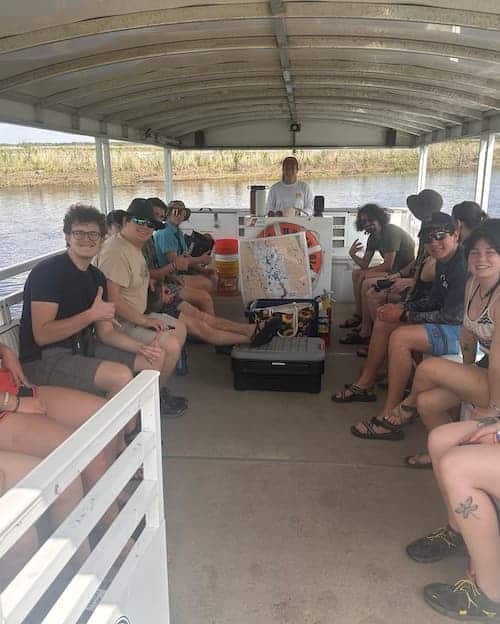
鈥淲etlands, pound for pound, are one of the highest biodiversity places on Earth,鈥� Dr. Holbrook said. 鈥淚n other words, they have more species of plant and animal than almost any other habitat, and they also produce the most plant and algae biomass that is food for everything else. We call that primary productivity. Wetlands are tied with coral reefs and tropical rainforests as being the highest in primary productivity.鈥�
For Dr. Holbrook, the bi-annual trip is a homecoming of sorts.
鈥淚 did most of my undergraduate and graduate work in Florida. I lived there for almost ten years and really didn鈥檛 run out of things to do,鈥� he said. 鈥淲e can easily slide from thing to thing down there and see all that Florida has to offer in terms of the different wildlife, the birds, the snakes, and the reefs, so it is a packed place.鈥�
Highlights of this year鈥檚 trip included surveying approximately 40 species of birds, finding shark teeth and a massive mastodon tooth along a river beach, snorkeling, and witnessing an alligator devouring a wild boar in the water. Another sighting of interest was chameleons, a non-native exotic species in Florida. Dr. Holbrook has previously been featured on National Geographic while collaborating with other universities to study the reptiles in South Florida.
鈥淐hameleons are always a fun and exciting species for the students to see,鈥� Dr. Holbrook said. 鈥淭here鈥檚 also a snake species down there called a mangrove salt marsh snake that I have worked with quite a bit with some of my collaborators in Florida, and we found a couple of those. They鈥檙e very friendly snakes. You can pick them up and they鈥檒l just hang out there in your hand, no biting.鈥�
Another significant aspect of the trip was a boat ride where students observed the Kissimmee River restoration, the second-largest environmental restoration project in history. In an effort to control flooding, the meandering river was transposed into a deep and straight canal in the 1960s through federal assistance and the work of the United States Army Corps of Engineers. The project nearly halved the river鈥檚 length between Lake Kissimmee and Lake Okeechobee from 103 miles to just 56 miles. However, the changes to the river did not produce the intended results. Since 1997, attempts have been made to restore the floodplain to its original state and reverse the devastating consequences the project had on the local ecology.

鈥淥ne of the problems they鈥檝e had with the Kissimmee River is actually increased flooding because they鈥檝e taken something with a big wide floodplain, which is a big wetland essentially, and turned it into this narrow channel that can overspill easily,鈥� Dr. Holbrook explained. 鈥淚n terms of human benefit, wetlands are important for things like flood control because they鈥檙e a big sponge on the landscape that鈥檚 able to suck up and hold onto water from rains.鈥�
While this year鈥檚 group ventured to southern Florida, future Field Studies trips will rotate between visits to northern Florida, the Carolina coast, Great Smoky Mountain National Park, and the ancient dune system of the Carolina Sandhills.
鈥淔or labs or classes, we may go half an hour or an hour away, but these Field Studies classes give us more time, so more distance, to get away and see more cool stuff,鈥� Dr. Holbrook said. 鈥淏ecause we鈥檙e small enough at 含羞草研究所, we鈥檙e able to get students out in the field a lot earlier than anywhere else. In a typical larger university, especially a large state college, you don鈥檛 get out into the field until your junior year, and that鈥檚 usually just locally.鈥�
Overall, Dr. Holbrook appreciates these field trips not just for their educational value, but also for the unique opportunity they offer to build deeper connections with his students.
鈥淭hese trips are great for being able to get out there with the students because you get to know them a lot better doing field work than you do in the classroom,鈥� Dr. Holbrook said. 鈥淚鈥檝e always enjoyed the opportunity to take people out and see people get excited about things I may have seen 1,000 times. That鈥檚 pretty cool to be able to feed off other people鈥檚 excitement.鈥�